1938 Wicks Direct Electric pipe organ
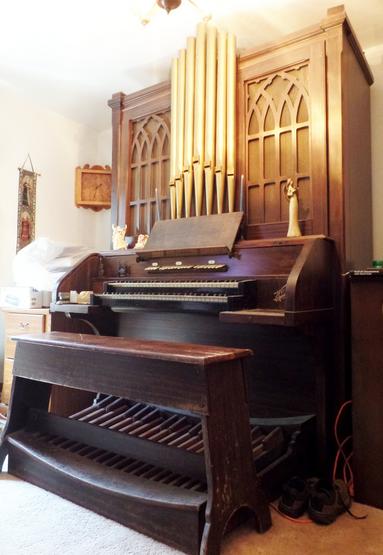
This is a 1938 (I am told by the prior owner) Wicks Direct Electric pipe organ. It has two full AGO manuals and, at least as I measure it and play it, a concave AGO 31-note pedalboard, C to F#. There are three ranks: wood stopped flue, metal string, and very soft metal dulciana. There is also a one-octave reed low extension for the pedals and the 16-foot stops on the manuals.
Stop List
Pedal
- 16' Subbass
- 8' Gedeckt
- 4' Flute
- 4' Violina
Swell
- 16' Bourdon
- 8' Quintadina
- 8' Stopped Flute
- 8' Viola
- 8' Dulciana
- 4' Flute
- 4' Dulciana
- 2 2/3 Nazard
- 8' Oboe
- Tremelo (never worked)
Great
- 16' Bourdon
- 8' Flute
- 8' Salicional
- 8' Dulciana
- 4' Flute D'amour
- 4' Violina
- 2' Piccolo
- Chimes (not present)
It has a swell pedal and a crescendo pedal, both of which were fully functional the last time the organ was seriously used and should be able to be made functional with just some contact cleaning. It is 98 inches tall, from the base to the top of the center facade pipe. It just barely fit in our house after I cut an inch or so from the center pipe. But because those front pipes are not speaking, you can safely shorten them if you need to fit it in your room. It is 64 inches wide and 66 inches deep, from the back of the pipe chest to the back of the pedalboard.
When I first assembled it 20 years ago, I'm fairly certain that it worked perfectly, or if not it was so close to perfect that it did not matter. My organist wife played it regularly and never complained about any imperfections. But since I built her a fancy digital organ 10 years ago she has not played it since. Due to the lack of playing, many of the keys and stop relays have become oxidized and need some cleaning, generally very easy though tedious.
Important Consideration for the Buyer
There is a major consideration for the buyer of this organ: I'm quite sure that you will NOT be able to reassemble it and make it work using the original wiring harnesses. They date from 1938, and so the insulation has become brittle and cracked. This means that you will have two choices if you want this to be a fully functional pipe organ:
- Make new wiring harnesses. This should not be as difficult as it might seem at first thought, because the contact layouts are linear and straightforward.
- My dream, which I never followed through on, was to MIDI it. Each manual, and the pedalboard, and the stop row, would have its own little MIDI board easily wired to the switches. This would leave you with just four small MIDI cables to replace all those monster wiring harnesses. Moreover, you would be able to supplement it with digital stops, MIDI recorders, sequencers, memory banks, and any number of other magical MIDI devices.
UPDATE... The organ has found a nice new home and is being lovingly rebuilt.